

Eyelid Lift
Eyelid surgery (eyelid lift or blepharoplasty) is performed to correct the aging of the eyelids. It can be done on the upper and/or lower eyelids. Excess skin and fat pads are removed. Upper and lower eyelid surgery can be done separately or in conjunction with each other. This procedure does not eliminate crow’s feet (the wrinkles around your eyes). Summit Plastic Surgery Fort Wayne offers this as an outpatient surgery, which lasts approximately 1 hour for uppers and 1 hour for lowers. Eyelid surgery may be performed with other facial procedures such as a forehead/brow lift, facelift, or laser resurfacing.
Blepharoplasty at a Glance
Eyelid surgery is one of the most requested facial procedures in the country. In 2023, surgeons performed more than 120,000 blepharoplasty procedures, marking a 5% increase over the prior year, according to the American Society of Plastic Surgeons.
| Procedure | Surgical — upper and/or lower blepharoplasty | Anesthesia | Local with sedation, or general |
| Procedure Time | About one hour per area | Setting | Outpatient surgical facility |
| Recovery Basics | Contacts and lifting restricted for at least one week | Return to Work | TBD (varies by case) |
| Results Longevity | Turns back the clock about five to 10 years | Common Pairings | Brow lift, facelift, laser resurfacing, injectables |
| Insurance | Lower lids: not covered. Upper lids: rarely, with a documented visual field test | Cost | TBD |
| Financing | Available — CareCredit | Consultation | Required to confirm candidacy |
What Happens During Blepharoplasty Surgery?
Blepharoplasty is an outpatient procedure, meaning you go home the same day. At Summit Plastic Surgery, it’s performed in a surgical facility, typically under local anesthesia with sedation or general anesthesia.
Once you’re comfortable, Dr. Corey makes carefully placed incisions designed to be concealed within natural creases in the area. For upper blepharoplasty, that means the crease of the upper lid. For lower blepharoplasty, the incision may sit just below the lash line or on the inside of the lid, depending on the approach. From there, excess skin is removed and the underlying fat is trimmed or repositioned to create a smoother, more refreshed contour, and the incisions are closed with fine sutures.
Plan on roughly one hour per area, so treating both the upper and lower lids takes longer than a single set. Because it’s a same-day procedure, you’ll rest in recovery for a short time (often around an hour) before heading home with someone to drive you. You’ll leave with clear aftercare instructions, and keeping your head elevated in those first days helps keep swelling and bruising to a minimum.
What’s the Difference Between Upper and Lower Blepharoplasty?
The short version: upper blepharoplasty treats the skin above your eyes, while lower blepharoplasty treats the puffiness and bags below them. They solve different problems and can be performed separately or together.
Upper blepharoplasty targets the hooded skin that tends to accumulate along the upper lid and rest on your lashes. Beyond looking heavy or tired, that extra skin can crowd your side vision when there’s enough of it. During the procedure, a small amount of loose skin (and sometimes fatty tissue) is removed through an incision hidden in the natural crease of the lid, so the healed line is tough to spot. Because upper lid heaviness is partly tied to brow position, Dr. Corey will also check whether a brow lift would give you a more complete result.
Lower blepharoplasty addresses the under-eye area, where the fat pads that cushion the eye can push forward over time and create bags or puffiness. Depending on your anatomy, this may require repositioning or reducing that fat and, in some cases, trimming a little loose skin. The goal is a smoother, more rested lower lid. When under-eye shadows or lost volume are involved, injectable fillers can complement surgery once you’re fully healed.
How Can I Know if Blepharoplasty Is Right for Me?
While meeting with Dr. Corey for an evaluation is the best way to see if you’re a candidate for this procedure, it’s also helpful to know which concerns you should be looking out for.
The eyes are one of the first places where signs of aging begin to take hold. With age, the upper eyelid skin can stretch and hood over the lash line, and the small fat pads that cushion the eye tend to shift forward. This creates that telltale puffiness and bags, resulting in a resting facial expression that reads as tired, sad or even a little annoyed.
In more advanced cases of hooded or heavy upper eyelids, there is also a potential for your field of vision to be compromised. You may notice that it is difficult to see things at the edges of your field of vision when driving or reading, because the descending tissue is beginning to encroach on your view.
If you notice any of the above signs, on their own or in combination, you may be a candidate for blepharoplasty. Most patients are in their mid-50s or older, but genetic factors and a growing interest in subtle, preventive procedures have led to more patients in their 30s and 40s undergoing this procedure.
During your evaluation, Dr. Corey will look at how your brows, lids and midface work together to provide an honest recommendation. Sometimes, the better answer is a brow lift, a nonsurgical option or a combination.
What Do I Have to Do to Prepare for Blepharoplasty?
Preparing for blepharoplasty is mostly about giving your body the best possible conditions to heal, which means planning ahead, potentially pausing a few habits and setting up your support system for the early days of recovery.
Every plan is a little different, and your exact instructions will depend on the specific approach and your health history. That said, you may be asked to complete some pre-operative labs or an eye exam and to temporarily stop certain medications and supplements that can increase bleeding and bruising.
These supplements and medications include:
- Aspirin
- Ibuprofen
- Fish oil
- Vitamin E
- Some multivitamins
- Prescription anticoagulants
If you smoke, you’ll be asked to quit for at least two weeks before surgery, since nicotine (including vaping) interferes with healing. It also helps to limit alcohol in the days leading up to your procedure.
Preparing for Early Recovery
Plan to arrange a ride home and, ideally, have someone stay with you the first night. Because keeping your head elevated is a key factor in the early recovery process, many patients set up a recliner or a stack of pillows ahead of time, along with cold compresses and lubricating eye drops within easy reach. Filling any prescriptions in advance means one less errand while you rest.
A few things not to do:
- Don’t stop any regularly prescribed medication without checking first
- Don’t plan surgery right before a major event since bruising takes time to fade
- Don’t expect to pop your contacts back in immediately
If applicable, you’ll be in glasses for about a week. If you have any questions related to ongoing eye care, the recovery process or other aspects of the post-op experience, our care team at Summit Plastic Surgery is here to help.
Can I Combine Blepharoplasty With Other Procedures?
Yes. Blepharoplasty pairs well with other facial treatments, including a forehead/brow lift, a facelift or laser skin resurfacing, and many patients combine procedures for more cohesive and natural-looking results.
Some complementary procedures can be added to the same surgical session, while others will have to take place separately from your blepharoplasty.
Potential Same-Day Procedures: Brow Lift and Facelift
When the eyelids and brow show a similar degree of aging, lifting the low brow at the same time as removing excess lid skin can produce a more harmonious result than either alone.
A facelift addresses the lower face and jawline, and because blepharoplasty doesn’t treat crow’s feet, laser resurfacing is a natural add-on to smooth the fine lines around the eyes. Combining surgeries also means one round of anesthesia and one recovery period.
Injectables and Fat Transfer
Injectable treatments like Botox and dermal fillers are typically done once you’re fully healed, to fine-tune your facial balance and soften any remaining lines. They are also an excellent option for restoring subtle volume around the cheeks and temples.
Fat transfer can play a similar role. As a Key Opinion Leader with Allergan Aesthetics, Dr. Corey is well-versed in how surgical and nonsurgical treatments work together, so he can map out a sequence that makes sense for your goals and your calendar. Whether a pairing is concurrent or staged is always a conversation, not a formula.
Why Trust Summit Plastic Surgery for Blepharoplasty?
Summit Plastic Surgery pairs board-certified surgical training with a patient-first attitude to bring you real expertise and a surgeon who keeps your goals front of mind throughout the plan.
A Fort Wayne native, Dr. Samuel Corey came home to serve the community he grew up in. He earned his medical degree at Indiana University School of Medicine, completed his general surgery residency at Mercer University in Savannah, Georgia, and finished a fellowship in plastic and reconstructive surgery at the University of Louisville. Dr. Corey is a double board-certified plastic surgeon whose areas of expertise include aesthetic and revision face and breast surgery. He’s also on the Advisory Board with Allergan Aesthetics, and Summit’s surgeons are proud members of the American Society of Plastic Surgeons.
If you’re curious whether blepharoplasty is right for you, the next step is simple. Schedule a consultation with Dr. Corey and the team at Summit Plastic Surgery in Fort Wayne, and let’s talk through what refreshed, natural-looking eyes could look like for you.
Patient Information
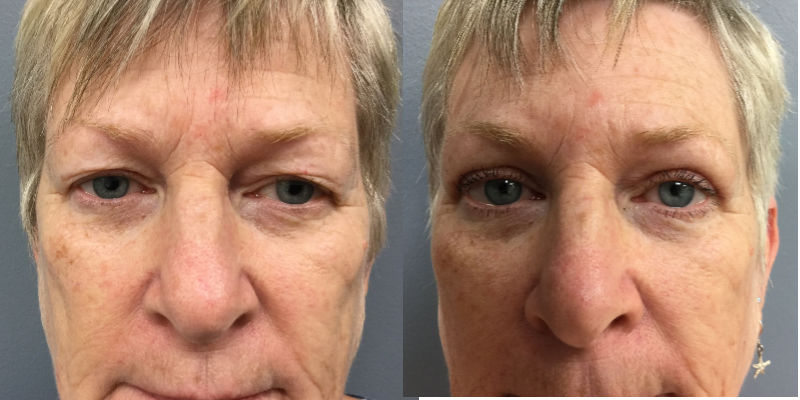
Upper Eyelids
1 month post-op
Everyone is extremely pleasant and makes you feel at ease.
Eyelid Lift: Common Questions
Who is a candidate for eyelid surgery?
Those people who have loose skin and/or bags around their eyes, and would like to put the skin back to the proportion it was when they were younger. Also those people that would like to look less tired and/or sad.
How long will it last?
It sets the clock back five to ten years, and then the gravity process associated with aging begins again.
Do you have to have all four eyelids done?
No, you can do just the upper lids or just the lower eyelids as well as both combined. The physician will discuss what is best for your particular situation. The best procedure for you may be a combination with something else more non-invasive.
Is the procedure done in the office?
For safety purposes it is performed in a surgical facility as an outpatient. The physicians usually request the procedure to be performed by local anesthesia with sedation or general anesthesia. You would go home an hour or so after the surgery.
Are there any restrictions after surgery?
Keeping the head elevated is a must the days after surgery. You would need to sleep in a recliner or pile pillows up to keep the head above the heart. You will not be able to wear contacts for at least a week following surgery. Lifting will be restricted to ten pounds for at least a week depending on how you heal. It is important not to raise your heart rate or blood pressure to keep the amount of swelling and bruising to a minimum.
What are the risks or complications?
There is a possibility of persistent dryness of the eyes, corneal abrasion or irritations, ectropian (lower lid retraction), incomplete closure, and visual disturbances. These are the risks and complications that occur infrequently and are specific to this operation. There is always the risk of bleeding and infection with all surgeries. If you are a smoker you must quit for at least two weeks before surgery because of a greater risk of scarring, poor healing, and skin loss.
Will insurance pay for this procedure?
The lower eyelid surgery is never covered by insurance. On rare occasion the upper eyelids may be covered by insurance if a taped and un-taped Visual Fields test performed by an eye doctor proves your vision is impaired by your upper eyelids.